
Credit - Stead Photos Facebook
Wrexham have dropped more points from winning positions than any other side in the Championship, yet the numbers suggest their problem isn’t psychological. Their record tells a story of fine margins, late deflections, and a team still adjusting to the pace of the division.
Despite the frustration, their overall performance hints at something encouraging. The same statistics that paint them as wasteful also reveal a side learning to compete against the Championship’s elite.
A team that leads, but cannot finish the job
Wrexham have dropped points from winning positions more than any other team in the division. They have scored first in sixteen matches this season, but only managed to win seven of those. For a side sitting ninth in the table, that is the single statistic keeping them out of the play-off places.
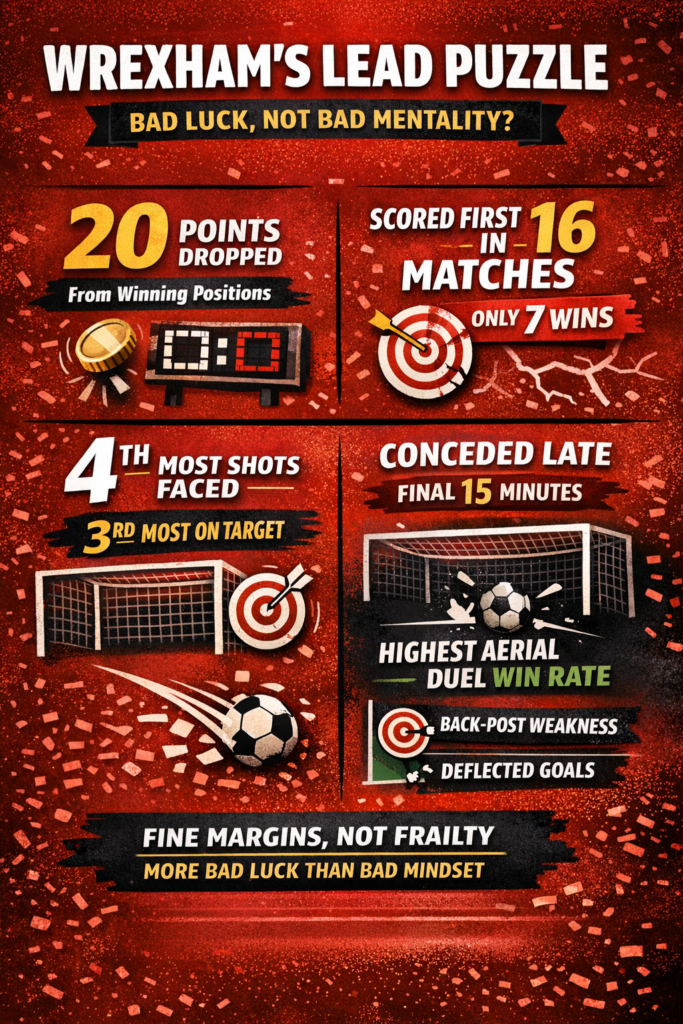
The team’s structure explains some of this. They have faced the fourth most shots and third most on target in the Championship. Sitting deep and defending in numbers limits big chances but invites pressure. It also creates a higher chance of deflections or rebounds, especially late in matches.
“Wrexham have scored the first goal in Championship matches sixteen times this season. Only Coventry have done it more. But they have only won seven of those sixteen games. That is a poor conversion from taking the lead to seeing out a win for three points.”
That imbalance defines their season. They dominate early, lose rhythm late, but the evidence suggests it is not about character. The goals they concede are often the result of chance, timing, or opposition quality, not hesitation or fear.
Patterns in the numbers, not in mentality
Wrexham have conceded late goals, and only three teams in the league have allowed more in the final fifteen minutes. Yet they also boast the highest aerial duel win rate in the division. Those two figures appear contradictory but actually underline the randomness of outcomes when defending deep.
Most of the setbacks from winning positions have followed isolated errors or bad luck. The Leicester match was decided by a second-half set piece. Norwich punished a counterattack. Watford benefited from a heavy deflection. Across those games, the only consistent pattern has been a back-post weakness, something that has already been addressed with returning defenders.
“The only repeated issue has been defending the back post. I do not personally look at Wrexham and think there is a massive mentality issue. They are not a soft touch.”
Their tactical shape, compact, reactive, and reliant on structure, leaves them open to statistical variance. When opponents get more shots from distance, more deflections will find their way in. That is not mentality, that is mathematics.
Their league position tells a truer story. Wrexham are currently ninth in the Championship, just two points shy of the play-offs. Their ability to create, recover, and chase games suggests resilience rather than fragility.
The numbers do not expose a flaw in Wrexham’s mentality. They reveal a side that belongs at this level, still learning how to turn control into consistency, and not far from finding that balance.
About The Author