
Credit: @robmcelhenney Instagram
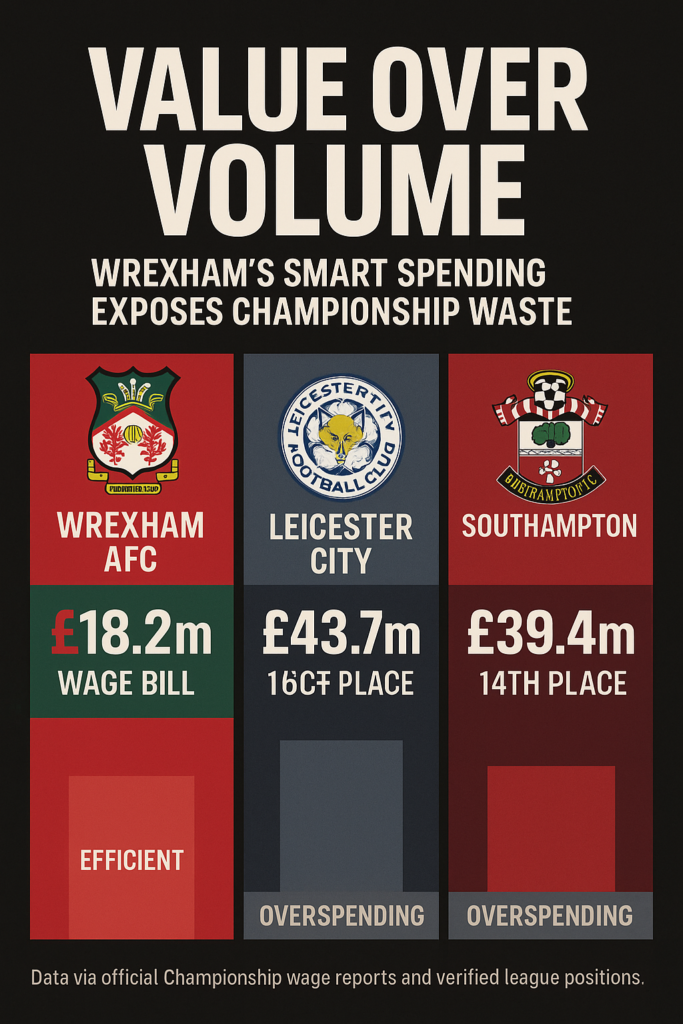
Wrexham sit tenth in the Championship with the division’s 11th-highest wage bill, outperforming clubs spending more than double their annual payroll. Leicester and Southampton prove money alone solves nothing.
The club’s position three points outside the play-offs reflects careful planning rather than reckless spending. An eight-match unbeaten run has lifted them into genuine contention in their first Championship campaign for 43 years.
Their wage structure tells the story of sustainable growth, not Hollywood excess. The £18.2m annual wage bill represents a significant jump from £11m in League Two, but it’s measured against Championship reality rather than panic.
The numbers don’t lie about who’s getting value for money. Wrexham’s £350,000 weekly payroll places them exactly where they should be based on spending, while bigger names flounder despite throwing cash at problems they can’t solve.
The numbers expose Championship dysfunction
Leicester carry a £43.7m annual wage bill yet languish in 16th place, spending more than double Wrexham’s total for a squad that delivers nothing. Southampton’s £39.4m outlay has them sitting 14th, proving that panic spending after relegation creates waste rather than results.
Both clubs arrived in the Championship with parachute payments and squads built for the Premier League. Neither adapted to the division’s demands or rebuilt with purpose, preferring to cling to expensive players who can’t deliver at this level.
Ipswich are the outlier among big spenders, their £29.6m wage bill reflected in seventh place. Even they’re spending significantly more than Wrexham while sitting just three points ahead, showing that intelligent recruitment matters more than raw budget.
Wrexham compete with former Premier League clubs despite spending half what most of them do. Kieffer Moore earns £30,000 per week as the top earner, a fraction of what Leicester’s highest-paid players command for far less output.
Structure built this, not luck
Phil Parkinson spent £33m over the summer knowing exactly what the squad needed for Championship football. That investment went to players who fit the system and understand what Wrexham demand, not big names bought to appease frustrated supporters or sell shirts.
Every signing arrived with a clear role and the mentality to execute it. The club didn’t chase Premier League cast-offs hoping their reputations would translate into points.
The wage progression from £6.9m to £11m to £18.2m across three seasons shows deliberate steps rather than desperate leaps. Each jump coincided with promotion and came with a plan for how the money would be spent.
The January transfer window will test whether that discipline continues under PSR constraints. Wrexham know they can’t keep spending at summer levels without sales, but the structure exists to navigate those limitations.
Wrexham’s league position proves their model works in a division that rewards planning over panic. Other clubs will spend more and achieve less because they lack the consistency and structure that defines every decision at the Racecourse.
Efficiency matters more than volume in the Championship. Wrexham’s 10th place with the 11th-highest wage bill isn’t luck or Hollywood money solving problems, it’s proof that structure beats chaos every time.
About The Author