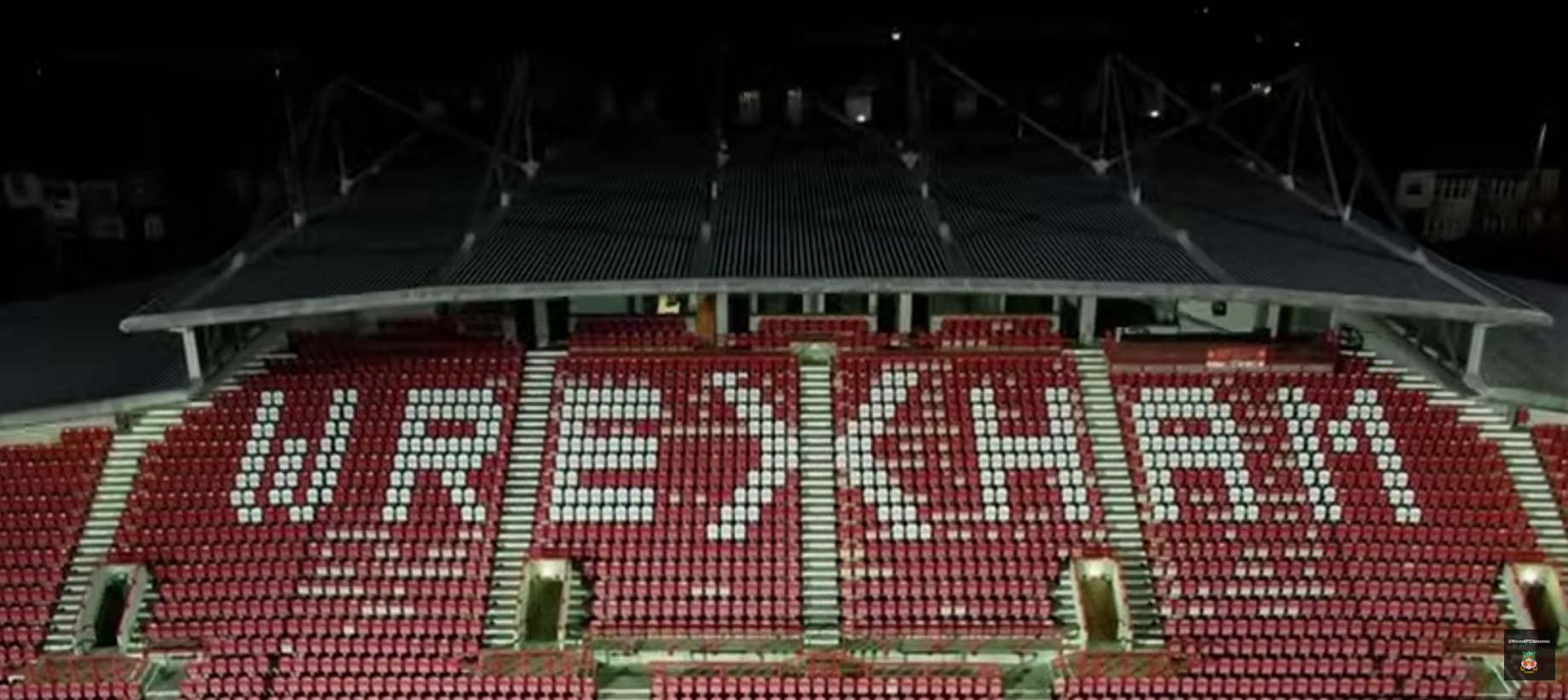
The Racecourse Stadium. Credit: Wrexham AFC Fanzone YouTube
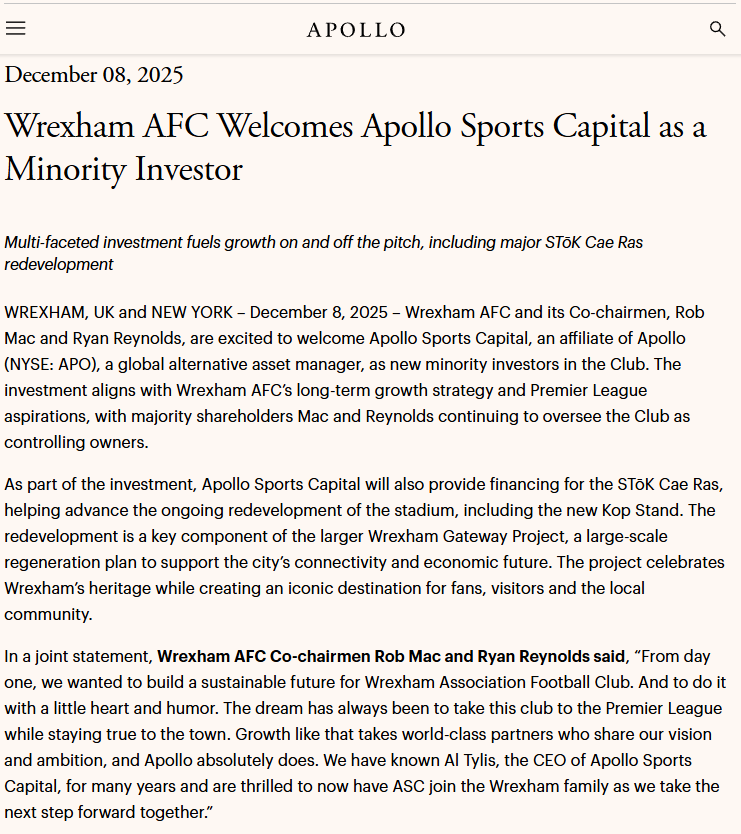
Apollo Sports Capital became minority investors in Wrexham AFC on December 8, 2025, purchasing less than 10 percent of the club at a valuation around £350 million. The investment provides crucial financing for stadium redevelopment while Reynolds and Mac retain 70 to 75 percent ownership, but the deal arrives alongside £18 million in Welsh government grants that sparked controversy about public funding for privately owned clubs.
The stake sale followed a pattern Wrexham established in October 2024 when the Allyn Family Office acquired approximately 15 percent through Red Dragon Ventures. Reynolds and Mcelhenney also sold five percent to a consortium fronted by Apollo CEO Al Tylis and Sam Porter, who previously invested in Mexican club Necaxa in a reciprocal shareholding arrangement.
The Athletic reports Apollo’s representative will join the Wrexham board in time, providing strategic input while the Hollywood duo maintain overwhelming control with up to 75 percent ownership through The R.R. McReynolds Company LLC.
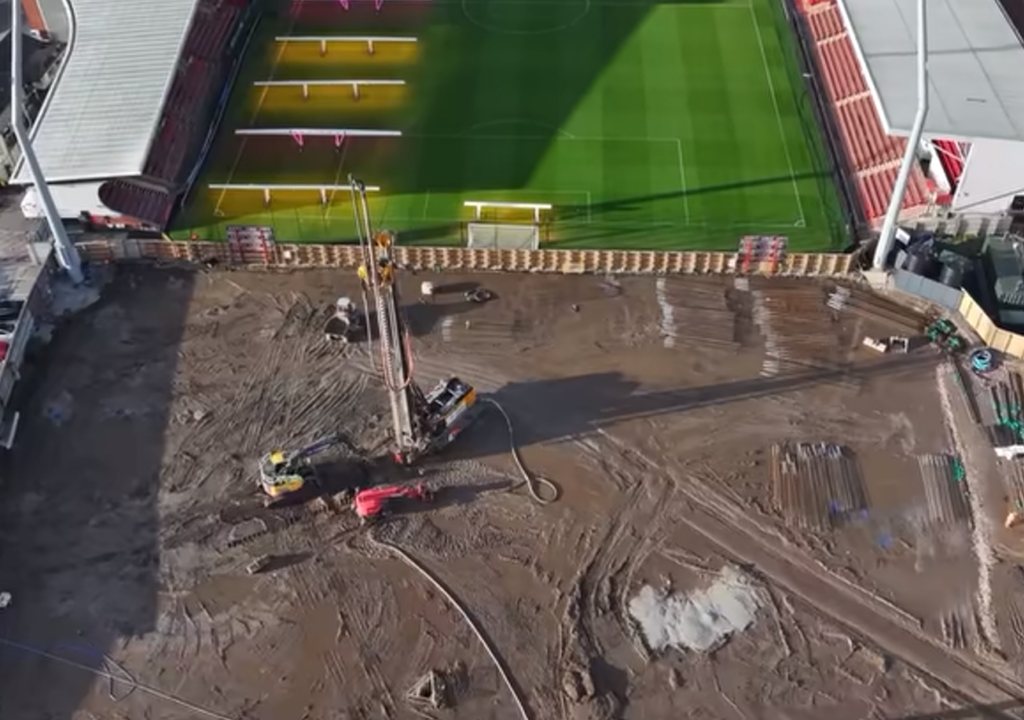
The investment specifically targets the new Kop Stand redevelopment at the STōK Cae Ras, where construction reached a critical stage after the official ground-breaking ceremony on December 4th performed by CEO Michael Williamson alongside Welsh government and council officials. Steel skeleton work begins in spring following foundation casting through December and January.
As Ollie Rathbone netted a stoppage-time equaliser against Watford to delight co-owners Reynolds and Mcelhenney in the stands, the familiar sea of mud at the Kop end remained alongside heavy machinery including an enormous piling rig. That backdrop has defined much of Wrexham’s return to the Championship this season.
Who Apollo Sports Capital are and what they bring to Wrexham
Apollo Sports Capital operates as the dedicated sports investment arm of Apollo Global Management, a New York-based alternative asset manager with approximately $908 billion in assets under management as of September 30, 2025. The firm launched ASC earlier in 2024 as a $5 billion platform specifically targeting sports investment with Al Tylis as chief executive officer.
Wrexham represents Apollo’s second major football investment within weeks. ASC acquired a majority stake in Atletico Madrid in November 2024, buying between 51 and 55 percent of the Spanish club valued at €2.5 billion.
The Atletico deal mirrors Wrexham’s approach closely. Apollo’s La Liga correspondent Dermot Corrigan noted Apollo’s involvement “fits with changes ongoing off the pitch at the La Liga club” relating to construction of the Estadio Metropolitano and the €800 million Ciudad del Deporte regeneration development on surrounding land.
That model proves remarkably similar to what now unfolds in north Wales, where the Wrexham Gateway regeneration project has the new Kop stand at its heart. The project celebrates Wrexham’s heritage while creating an iconic destination for fans, visitors and the local community.
Apollo Partner and Co-Portfolio Manager Lee Solomon confirmed ASC’s strategy centres on providing “long-term, patient capital to help Wrexham reach its goals and to contribute to the ongoing revitalization of the facilities and local economy.” Reynolds and Mcelhenney specifically referenced their existing relationship with Tylis, stating they have “known Al Tylis, the CEO of Apollo Sports Capital, for many years.”
That prior connection through their reciprocal investment in Club Necaxa facilitated negotiations and aligned expectations around Wrexham’s long-term vision versus immediate profitability. Apollo gains one board seat as part of the investment, providing input on strategic decisions while Reynolds and Mcelhenney retain final authority over club direction.
The Athletic notes Apollo was brought on board primarily to finance stadium redevelopment rather than transfer spending. Costs for the new stand spiralled since initial plans were revealed when Wrexham played non-league football, requiring outside investment as the club’s contribution rose markedly.
Apollo’s other sports investments include stakes in the Mutua Madrid Open and Miami Open tennis tournaments in partnership with Ari Emanuel and Mark Shapiro’s new company MARI. The firm previously provided an £80 million loan to Premier League club Nottingham Forest, demonstrating its willingness to deploy capital across different sports investment structures.
Through its Athene retirement services division, Apollo specializes in helping clients achieve financial security by providing retirement savings products and acting as a solutions provider to institutions. The firm’s patient, creative and knowledgeable approach to investing aligns its clients, businesses and communities to expand opportunity and achieve positive outcomes.
Public funding controversy centres on non-refundable grants
The Apollo investment arrived after £18 million in grants was set aside by the Welsh government via Wrexham’s borough council for the Kop redevelopment. As outlined in 2023, what caused considerable recent consternation was confirmation the grants to Wrexham will be non-refundable.
Most football developments funded substantially by public money typically see councils retain either full ownership or substantial stakes. The stadiums built for Huddersfield Town in 1994 and Hull in 2002 followed this model, protecting taxpayer investment through ongoing ownership.
At a time when national and local authorities face huge financial pressures, the optics of public money going to a club run by already very successful and rich businesspeople drew criticism from several quarters. Football finance expert Stefan Borson told the Irish Examiner the Apollo investment “confirms the commercial attraction of Wrexham to one of the largest investors in the world” but questioned why the Welsh government needed to provide £18 million in non-repayable grants given this private backing.
Borson argued it was “highly likely that the owners would have paid for it themselves” because stadium redevelopment is “fundamental to the football club” and necessary for any club with Premier League ambitions. He suggested every club pursuing top-flight football requires four complete stands regardless of government support.
Wrexham became the only club in Britain to receive such substantial direct state grants. Most other clubs receive support through local council assistance rather than direct government grants, making the £18 million particularly notable in the current financial climate.
The Wrexham Gateway scheme was first conceived in July 2019, a year or so before the Hollywood actors arrived on the scene. Split into two parts including redeveloping Wrexham General Station a couple of hundred yards from the stadium, the project aimed to transform the main entry point to the city and support connectivity and economic future.
Previous attempts to bankroll the scheme via the UK government’s £2 billion Levelling Up fund failed. This left a substantial hole in funding, which was plugged when the Welsh government pledged in 2022 to reallocate money from the eastern Gateway scheme side at the station to the western Racecourse side.
A report to the council’s executive committee, which subsequently voted the proposal through unanimously in April 2023, estimated the overall scheme would create 732 jobs, deliver £54.1 million gross value-added impact, and result in £3 of public benefit for every £1 invested. Those projections formed the economic justification for committing public funds to the project.
A desire to bring more international sport, particularly football and rugby, to north Wales partly explains the government’s contribution. The Welsh men’s football team have played once in the region at the Racecourse since 2019, highlighting the limited international use the stadium currently receives.
The Welsh government stated the funding represents grant assistance for “the transformative Wrexham Gateway project” with the stadium development as one element. A spokesperson confirmed Wrexham and its owners are:
“Providing the majority of funding while public sector backing will make the crucial difference between the club satisfying league requirements and meeting the more demanding international fixture standards.”
The spokesperson added that other elements of the Wrexham Gateway:
“Will also require public investment, and we are working closely with local partners to identify appropriate sources of funding.”
This suggests further public money may flow into the broader regeneration project beyond the stadium itself.
Wrexham’s borough council stated the Gateway project “will attract significant new jobs and investment to north Wales” and confirmed “the grant is not repayable, however, there are conditions attached to the funding” without specifying what those conditions entail or what enforcement mechanisms exist.
The club defended the public investment by highlighting international sporting events in north Wales as “a catalyst for local job creation” and “an overall economic uplift to the region due to the increased number of visitors attracted to the events and their economic activity while they are in the area.”
However, Borson questioned how frequently Wales would actually play at the Racecourse given Cardiff’s significantly larger capacity makes it the obvious choice for most international matches. He suggested Wrexham might host “not more than one game per season for international football, if that.”
The controversy deepened because the grants came while local schools faced £3 million deficits and the council warned of potential staff redundancies without increased Welsh government funding. The apparent prioritisation of stadium development over education and public services drew particular criticism.
What the investment means for stadium development and Premier League ambitions
Work on the new 7,500 capacity Kop Stand is set for completion early in 2027, the first phase of a masterplan designed to turn the world’s oldest international stadium that continues to host international games into a venue befitting the Premier League team Reynolds and Mac hope Wrexham will become.
Wrexham’s rise through four successive promotions brought a rethink last year meaning the finished Kop will be fully compliant with UEFA Category 4, the highest grade possible. State-of-the-art dressing rooms, media facilities and safe-standing areas mean the upgrade will not come cheap.

With the size of the Welsh government grant remaining unchanged at £18 million despite these enhanced plans, Wrexham’s contribution to the overall project cost rose markedly from initial estimates. The club’s improved financial position made increased self-funding possible, but Apollo’s investment removes immediate pressure around spiralling costs.
McLaren Construction Midlands and North was appointed in September to carry out the development. The contractor will oversee foundation work through December and January before the steel skeleton rises in spring, creating the visible structure that will define the Racecourse’s transformation.
Manager Phil Parkinson was kept in the loop by CEO Williamson during Apollo talks before receiving notice last Sunday that a deal would be announced the following day. Anyone expecting Apollo’s arrival to signal even more transfer spending will be disappointed, with the investment targeted specifically at stadium infrastructure rather than squad strengthening.
Wrexham’s revenue reached £26.7 million for the 2023-24 season, a 155 percent increase from £10.5 million the previous year. Broadcasting deals, sponsorship growth and global exposure from the Welcome to Wrexham documentary series drove that commercial expansion, which underpins the £350 million valuation Apollo and other investors place on the club.
The valuation represents an 18,900 percent increase from the £2 million Reynolds and Mac paid in 2021, demonstrating the remarkable value creation achieved through three consecutive promotions. Wrexham achieved a third straight promotion, a feat matched by only a few clubs in English football history, earning promotion into the EFL Championship.
The club formed in 1864 stands as the oldest club in Wales and the third oldest professional team in the world. Wrexham have won the Welsh Cup a record 23 times and beaten some of the biggest clubs in the game in the English FA Cup and UEFA European Cup Winners Cup.
Reynolds and Mac pursue their Premier League goal through four guiding principles. First, to protect the heritage of Wrexham AFC. Second, to reinforce the values of the community. Third, to use their resources to grow the club’s exposure at home and abroad. Fourth, to create a winning culture both on and off the pitch.
The investment provides financial stability as Wrexham navigate their first full second-tier season while building infrastructure for potential Premier League football. Planning constraints limit how large the stadium can ultimately grow, but the new Kop represents the critical first phase toward creating a Premier League-ready venue.
Apollo’s expertise across sports, media and entertainment ecosystems offers resources beyond capital injection alone. The firm’s experience with Atletico Madrid’s regeneration project and involvement in major tennis tournaments provides knowledge transfer opportunities as Wrexham executes its own ambitious development plans.
Whether Apollo’s backing translates to January transfer investment remains unclear. The capital exists to support squad strengthening if Parkinson and the board determine it necessary for promotion ambitions, but the primary purpose remains stadium infrastructure rather than player acquisitions.
Embed from Getty ImagesCEO Michael Williamson stated Apollo’s investment:
“Represents both confidence in the Club’s direction and commitment to our long-term vision. Together, we will continue to strengthen Wrexham AFC on and off the pitch, building a sustainable future for the Club for our supporters, our community, and the generations to come.”
The partnership strengthens Wrexham on and off the pitch while building sustainable foundations that align with Reynolds and Mac’s stated vision of taking the club to the Premier League “while staying true to the town” that has supported them through 161 years of history.
About The Author