

Wrexham's true Championship position revealed as expected table exposes worrying attacking numbers. Credit: Wrexham AFC
Wrexham’s early-season results appear to match their performances, according to a new expected points table, but the underlying attacking data may give Phil Parkinson reason for concern.
Football analyst Mark O’Haire’s latest figures, shared on X, place Wrexham 13th in the Championship based on expected points per game over their first 11 fixtures.
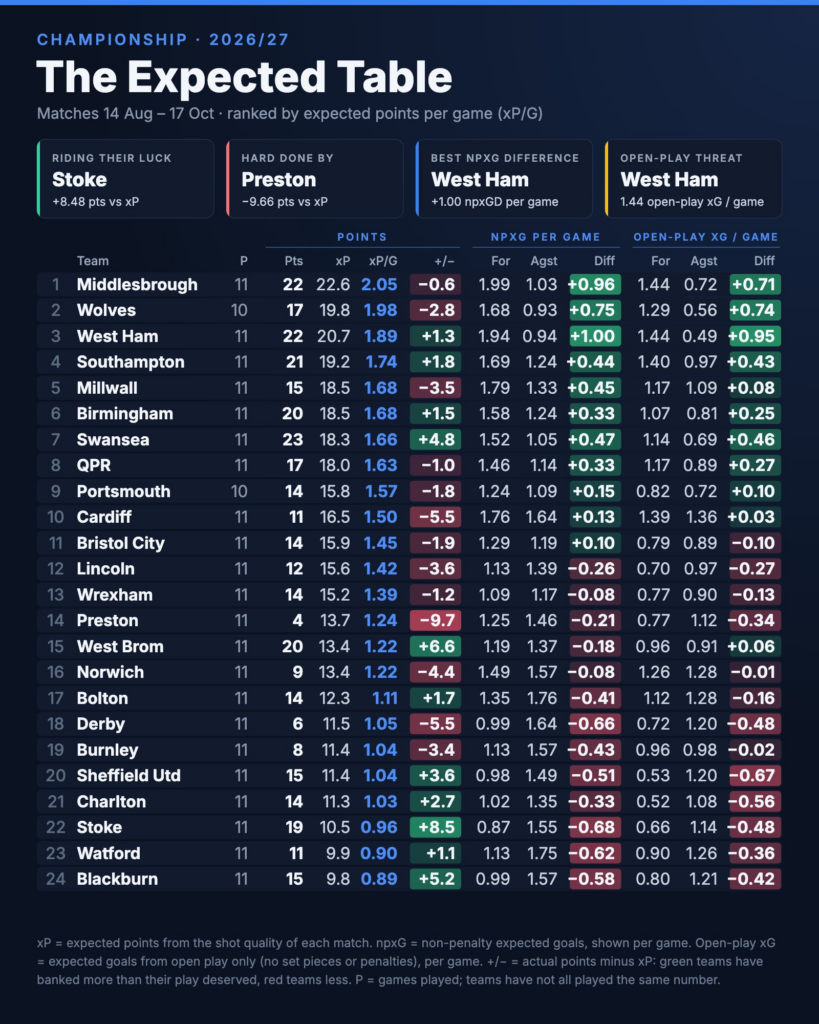
O’Haire prefaced his table with the words: “League tables lie.” His analysis covers matches from 14 August to 17 October 2026, weighing up actual points against those predicted by the quality of chances created and conceded.
Wrexham’s expected points compared to reality
Wrexham have 14 points from 11 games, compared with 15.2 expected points according to O’Haire’s model, a difference of just 1.2. Their 1.39 expected points per game places them 13th in his alternative table, rather than necessarily in the actual Championship standings.
That modest gap doesn’t suggest Wrexham have been particularly unlucky, nor does it hide a team playing well above their current position. The more pressing issue lies in their balance of chances at both ends of the pitch.
Wrexham are generating 1.09 non-penalty expected goals per match while conceding 1.17, leaving them with a negative differential of 0.08. In open play, the deficit is slightly wider: 0.77 xG for, 0.90 against, a gap of 0.13 per game.
While these numbers reflect chance quality rather than actual goals, the trend of conceding slightly better opportunities than they create is something Parkinson will want to address.
Recent results reflect a mixed picture
Wrexham’s recent fixtures highlight why a single result rarely tells the full story. They salvaged a 1-1 draw at Derby County on 10 October, followed by a 2-1 home defeat to West Brom, before bouncing back with a convincing 4-1 victory over Preston North End.
The Preston result, featuring goals from Joe Worrall, Ben Whiteman, Sam Smith and Kieffer Moore, showed Wrexham’s ability to be clinical. However, the broader attacking numbers across the season paint a less explosive picture than that one-off scoreline might suggest.
Parkinson has previously spoken about the value of away points, as he noted after the Derby match. Following the win over Preston, he also emphasised the importance of blocking out external noise and focusing on the team’s response.
Neither comment was a reaction to O’Haire’s analysis, but both underline the manager’s focus on consistency and improvement.
Stoke and Preston highlight extremes in the table
O’Haire’s expected points table also sheds light on some of the league’s outliers. Stoke, for example, have 19 points despite an expected total of just 10.5, a positive swing of 8.5 points.
Preston are at the other end, with only four points from an expected 13.7, a deficit of 9.7.
Middlesbrough, meanwhile, have 22 points from an expected 22.6 and lead the expected points table with 2.05 per game. For Wrexham, the relatively small gap between their points and expected points suggests that focusing on improving performance quality, rather than waiting for luck to change, is the more realistic path forward.
What expected points can and can’t tell us
Expected points use shot-quality data to estimate match outcomes. Non-penalty xG excludes penalties, while open-play xG also removes set pieces.
These metrics provide context beyond the league table, but they aren’t definitive predictions.
With just 11 games played, the sample size remains small. And while O’Haire’s numbers are model estimates rather than independently verified totals, they still offer a clear message for Wrexham: results are broadly in line with performances so far, but progress will likely depend on creating better chances while limiting those given away.
About The Author